 Cowork
Racing lines in an FPV sim: how to fly through rings fast and clean
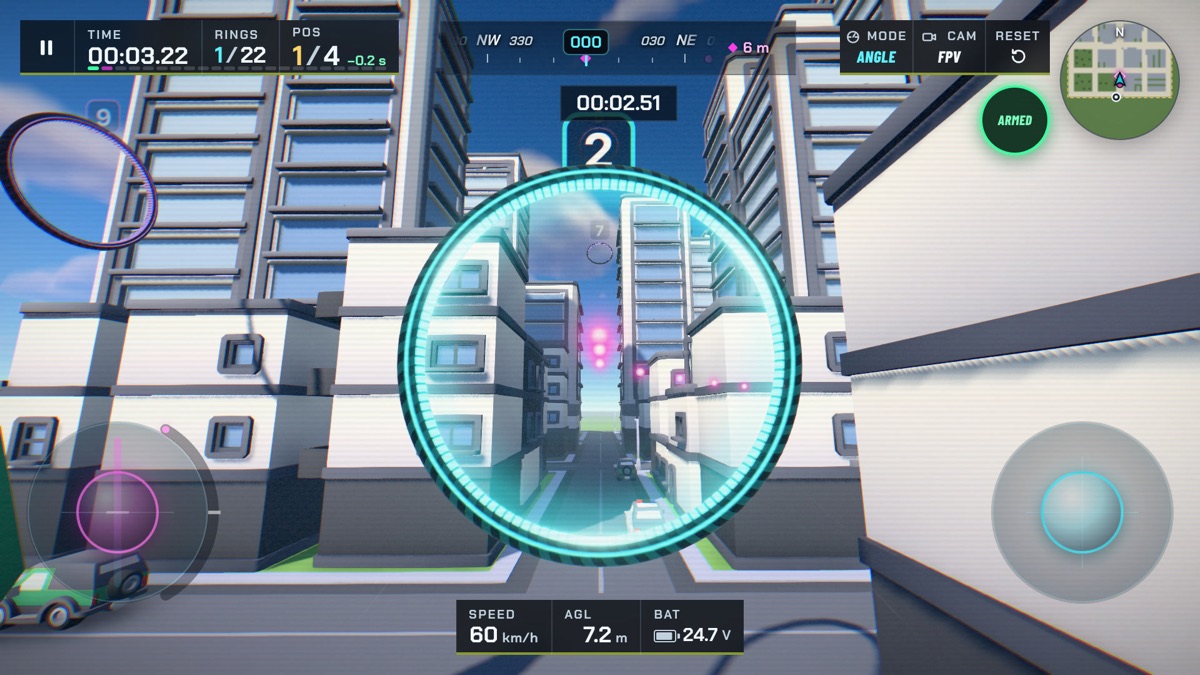
Once you can hover and fly a lap without crashing, the next question is why other pilots are seconds faster on the same course. Usually it is the line: where the quad is, which way it points and how fast it is going at each ring. This guide is a practice plan for racing lines, using Drone Sim as the practice tool. It assumes you can already hold height in Angle mode; if not, start with the throttle control guide.
What a racing line is
A racing line is the path through a course that lets you keep the most speed for the least correction. On a ring course you do not have to fly through the centre of each ring at a right angle. You have to pass through it, in order, and be set up for the one after. A good line treats two or three rings as a single shape, not as separate targets.
The slow way is ring to ring: aim, fly to it, pass it, then look for the next one and turn. The fast way is to pass each ring already turning towards the next.
Look one ring ahead
The single biggest habit to build is where your eyes go. The course guide's tip for the City says it plainly: the skybridges come up fast, so look one ring ahead, not at the ring you are about to pass. That applies everywhere.
By the time a ring fills your screen, your line through it is already decided. The big choices (how wide, how high, how fast) are made seconds earlier. As soon as you are lined up with a ring, move your attention to the next one.
- On your first laps of a new course, fly slowly enough to name the next ring before you reach the current one. If you cannot, slow down.
- Press V to show the heading arrow while you learn a route, then turn it off once you know where the rings are.
- On narrow courses such as Hoi An by Night, fly with the chase camera first to learn the turns, then switch to FPV, as the course guide suggests. Chase shows you where the quad sits in the street; FPV shows you what it sees.
Entry and exit: set up wide, pass tight
Every ring that needs a turn after it has three parts: the approach, the pass and the exit. The common beginner line is to arrive dead centre and then turn hard afterwards. The better line comes in from the outside of the coming turn, passes through the ring close to the inside edge, and is already banking as it clears.
Think of a car taking a corner: wide on entry, the apex at the ring, wide on exit. If the next ring is to the left, approach from the right side of the current one.
Height works the same way. If the next ring is higher, pass through the current one in its upper half and climb on the way out. If the next ring is lower, pass low and keep the nose down. Toy Town's tip from the course guide is a good example: the rings over the towers reward a smooth climb started early, not a hard pull-up at the last moment.
The one rule that overrides all of this: clean beats clever. Rings only count in order, so a clipped ring or a miss costs far more than a slightly slower line. Start with lines that pass well inside the ring and tighten them as you get consistent.
Carry speed instead of braking
In Angle and Acro nothing brakes for you. To slow down you tilt back against your direction of travel, which means turning momentum into a stop and then spending power to build it again.
This is also why GPS mode is slow for racing. The flight modes guide explains that because the controller keeps braking and levelling, you cannot carry momentum through a turn the way a racer does. Angle lets you keep speed through turns within its tilt limit (55 degrees by default). Acro removes the limit entirely.
To carry speed, turn with a bank, not with yaw alone. Yawing a level quad points the nose somewhere new while it keeps sliding the old way. Rolling into a bank with a little yaw and pitch makes it curve. In Acro this is the core racing movement; in Angle you get the same effect by holding the right stick diagonally and blending in yaw.
There are places where slowing down is the fast choice. The Night Loft has a ceiling fan whose blades really are solid, and the course guide says to keep your speed down through the first rings and watch the fan's rhythm before you commit. A crash on the fan costs much more than a second of patience.
Throttle in turns
When the quad banks, part of the motors' push goes sideways instead of up, so a banked turn loses height unless you add throttle. The tighter the turn, the more you need. As you roll back to level, take that extra throttle out, or the quad shoots upwards on the exit and you arrive at the next ring too high.
Keep the throttle moving through the whole turn: a little more as the bank builds, easing off as you level.
The Alpine Valley tip from the course guide applies to any climb: carry speed into it by tilting forward before you add throttle, the way real pilots do.
On Hoi An by Night and Ha Long Bay, touching the water ends your run. On Ha Long Bay the course guide suggests flying a metre or two higher until you know the line, and the same margin helps along the river in Hoi An.
Sprint or Full: which route to practise
Most courses have two routes: Full, the whole course, and Sprint, a shorter cut for quick races and leaderboard attempts. They train different things.
- Sprint routes are for repetition. The Night Loft Sprint keeps six of its twelve rings, Toy Town keeps fourteen of twenty-two, Hoi An by Night twelve of twenty, Ha Long Bay thirteen of forty-eight, Alpine Valley eight of sixteen, and the City Sprint is the last six of its eighteen rings. Short laps mean many attempts per session, which is how a line gets polished.
- Full routes are for consistency and focus. Forty-eight rings on Ha Long Bay asks you to stay clean for a long time, a different skill from nailing six rings once.
A simple split: spend most of a session on one Sprint, then finish with one or two Full laps of the same course.
Drills per course
Training Field: the three-ring loop
The Training Field has three big rings and nothing to hit. Fly continuous laps through them without stopping, trying to make each lap one smooth loop. Then fly the same loop in Acro.
Toy Town: early climbs
Wide streets and an open sky make Toy Town the friendliest outdoor course for a first real race. Fly the Full route and focus only on the rings over the towers: start each climb a beat earlier than feels natural and see whether the split time at that ring improves. Then race the Novice and Rookie bots.
Night Loft: tight lines
The Night Loft is short, technical and unforgiving of wide lines. Fly it with Dome, whose prop guards let it bump off walls. The drill is to pass each ring with the quad already pointed at the next, at low speed. Speed comes later.
City: eyes up
Fly the City Sprint, the last six rings, and call out each ring in your head as soon as the previous one is behind you.
Alpine Valley and Infinite World: long lines
Alpine Valley is the course for speed and big lines: long straights, climbs over ridges and dives towards the lake. Infinite World generates endless countryside from a seed, and the course guide calls it the best place to practise a long, smooth line over unfamiliar ground. Share a world code with a friend and you both fly exactly the same route.
Common mistakes and fixes
- You make every ring but the lap is slow. You are flying ring to ring. Look one ring ahead and start each turn before you pass the current ring.
- You overshoot after a ring and swing back. You arrived too fast and too straight. Approach wider so the turn is gentler, or come in slower.
- The quad sinks in every turn. No throttle added for the bank. Add a touch as you roll in.
- The quad balloons up after a turn. The turn throttle was never removed. Ease it off as you level.
- Clipping the edge of rings. Your line is too tight for your consistency. Aim for the inner third of the ring, not the edge, until laps are clean.
- The quad feels twitchy on straights. Check your rates. Racers often use lower rates for smooth lines; lowering center sensitivity or adding a little expo calms the stick near centre.
Learn from ghosts and split times
Drone Sim records the split time at every ring and keeps your best, so after each lap you can see exactly where you gained or lost time. Pick one ring per session to work on, not the whole lap.
Every course can also be flown as a Time Trial against your own best ghost. Racing your ghost shows the difference between two lines directly: if it pulls away through a turn, its line there was better.
Leaderboards go further. As the online racing article describes, every row on a leaderboard has its ghost attached, so you can pick any pilot and race their best lap on your own to see exactly where they take the faster line. Boards are kept per course and per drone class, with tabs for touch, keyboard, gamepad and VR, so compare yourself with pilots on the same quad and controller. Pick a ghost a little faster than you, not the record holder: the gap is easier to read.
When your lines are clean, the AI opponents are the next test. Novice, Rookie and Pilot fly in Angle; Ace and Pro fly in Acro. For pure time, the drone guide recommends Bolt in Acro on any Sprint route, but it is the least forgiving quad in the game. Learn the line on Strider first.
Keep it short and repeatable
Racing lines come from many laps of the same few rings. You can practise right now in your browser at dronesim.coworkgamestudio.com/play/, or get the game for iPhone, iPad, Mac and Android, or free to try on Meta Quest, from the Drone Sim page.
Have a question about this article or found something that does not match the game? Write to us at support@coworkgamestudio.com.